
What an Elderly Care Domestic Helper Does
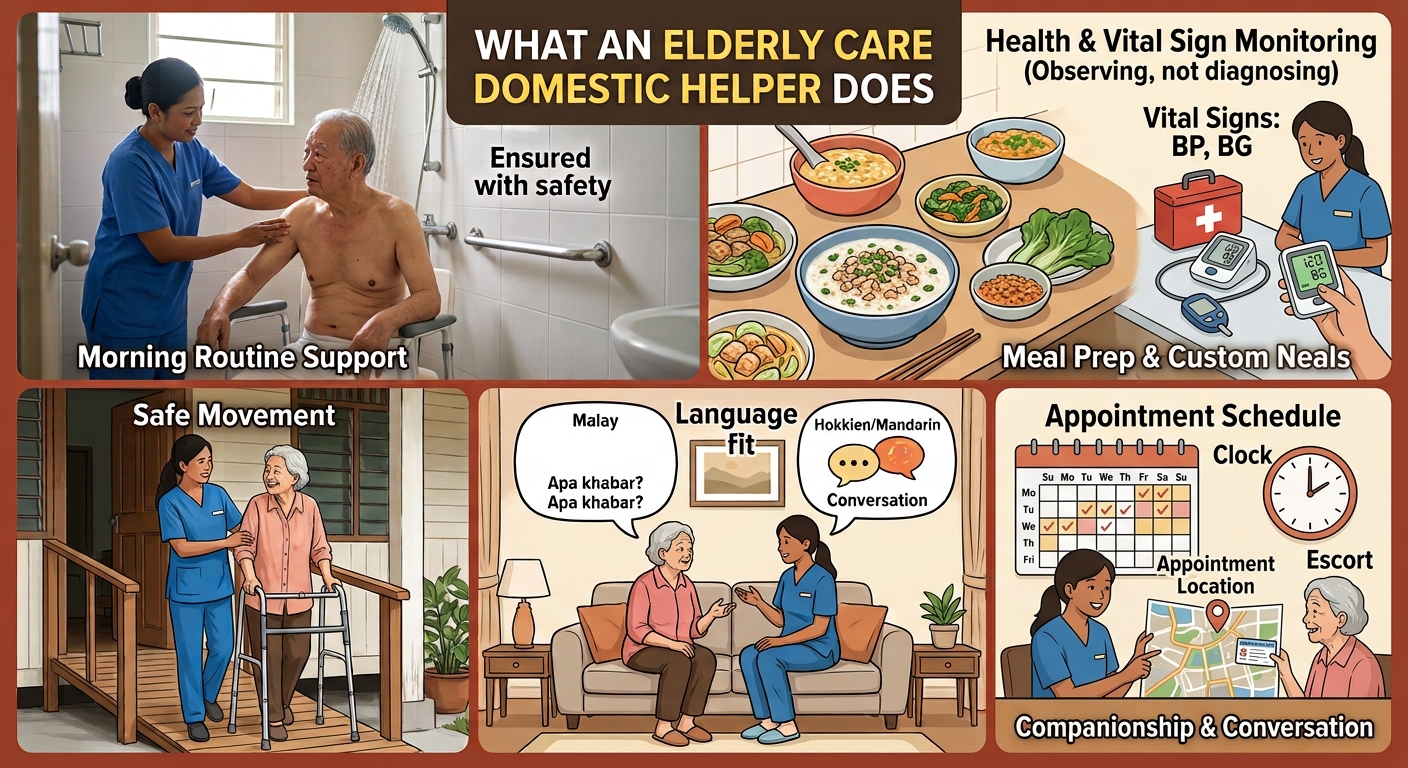
An elderly care domestic helper assists an elderly family member with the daily personal and practical care tasks that are becoming difficult to manage independently. The scope of care varies by the person's level of mobility and cognition, but typically includes:
- Morning routine assistance — bathing or showering support, dressing, oral hygiene
- Mobility assistance — safe movement around the home, preventing falls, supporting to and from the toilet
- Meal preparation — cooking appropriate meals, managing dietary requirements (soft food, diabetic diet, reduced sodium, etc.)
- Medication reminders — ensuring scheduled medications are taken at the right time and in the correct dosage (the helper does not administer medications — they remind and assist the elderly person in self-administering)
- Companionship — daily conversation, accompanying to appointments, light activity like walks or simple exercises as directed by a physiotherapist
- General household care — keeping the elderly person's living space clean, laundry, and household tidiness
What We Look for When Matching an Elderly Care Helper
Not every domestic helper is suited for elderly care. The role requires patience, empathy, physical capability, and the ability to remain calm in situations that can be emotionally and physically demanding. When matching for elderly care, PMA specifically assesses:
- Prior experience with elderly care — previous employers, care facility training, or family caregiving background
- Physical fitness and mobility — some elderly care roles involve physical lifting or transfer assistance
- Communication style — gentle, clear, and patient is the priority
- Language — for elderly family members who are more comfortable in Malay, Hokkien, or Mandarin, we flag language proficiency explicitly in each profile
- Temperament — assessments from previous employer references and our own interview process
Indonesian vs Filipino for Elderly Care
For elderly family members who speak primarily Malay or a Chinese dialect, Indonesian domestic helpers are typically the stronger choice — the language barrier is significantly lower, and the cultural familiarity reduces friction in daily personal care situations.
For households where the elderly person is English-comfortable, or where the working adult family members prefer English-medium communication with the helper, a Filipino helper may be the right fit.
We discuss this carefully at your first consultation — the right fit for your specific elderly family member matters far more than any general rule.
Where We Place Elderly Care Helpers Most
Elderly care is the most common placement type in our Kedah and Penang branches, reflecting those regions' multi-generational household culture and older demographic profile. It is also a significant portion of our Puchong placements, where working adult children often need a helper to care for a parent who has moved in.
Questions to Ask Yourself Before Enquiring
Having clear answers to these questions at your first consultation will make the process faster and the match more accurate:
- What is the elderly person's primary care need — mobility, personal hygiene, companionship, or a combination?
- Does the elderly person have any medical conditions the helper needs to be aware of?
- What language does the elderly person feel most comfortable speaking?
- Is this a live-in arrangement? Is there a dedicated room for the helper?
- Are there other household members (children, working adults) the helper will also interact with?
Elderly Care Helper — Placement in Kedah
"In our Alor Setar branch, elderly care accounts for more than half of all placement enquiries. Families from Alor Setar, Jitra, and Sungai Petani are caring for an ageing parent at home and need a helper who can manage the daily care independently while the family works. The right match here requires patience, language fit, and genuine care experience — not just availability."
— PMA Alor Setar, Kedah