
What a Childcare Domestic Helper Does
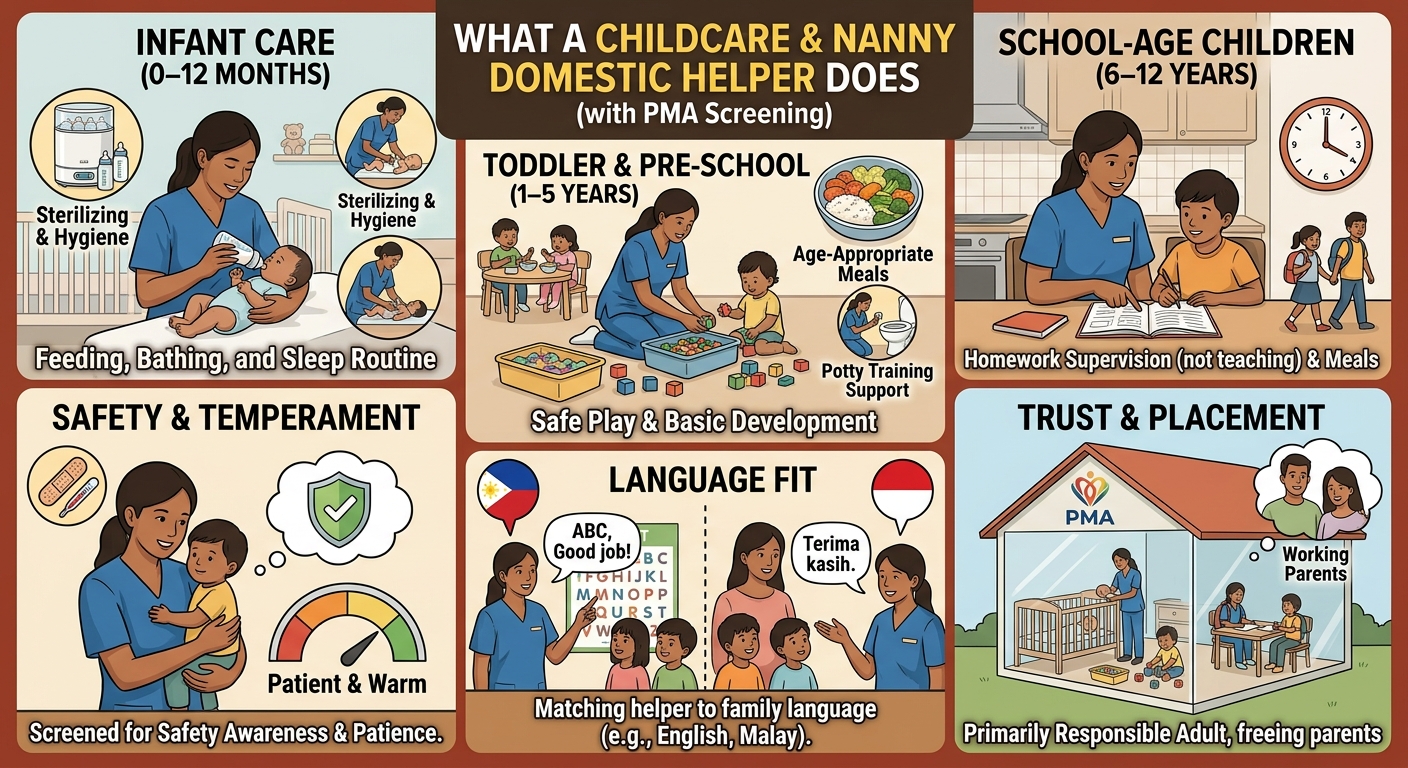
A domestic helper placed for childcare responsibilities supports the daily care and supervision of children — freeing working parents to be fully present during the hours they are home, rather than arriving to find the household chaos the helper was supposed to prevent.
Childcare duties vary significantly by the age of the children and the household's schedule:
Infant Care (0–12 months)
- Feeding (bottle feeding, supplementary feeding support for breastfeeding mothers)
- Bathing and changing
- Sleep routine management
- Sterilising equipment and maintaining hygiene
- Monitoring for illness and communicating with parents
Toddler and Pre-school (1–5 years)
- Safe supervision during play and outdoor time
- Meal preparation for young children — age-appropriate portions and textures
- Potty training support
- Basic developmental activities — storytime, simple games, sensory play
- Kindergarten pickups where applicable
School-age Children (6–12 years)
- School runs — walking to school, accompanying on public transport, or supervising at the school gate
- After-school meal preparation and snacks
- Homework supervision — ensuring homework is completed, not teaching curriculum
- Communicating with parents if a child is unwell or an issue arises
What Makes a Good Childcare Placement
The Puchong branch sees childcare placement requests most frequently — Bandar Puteri and the surrounding Klang Valley townships have a high density of dual-income households where both parents leave before 8am and return after 7pm. In these homes, the helper is the primary adult responsible for the children during the day.
This requires a different kind of trust and a different kind of screening than a general housekeeping placement. We specifically assess:
- Previous childcare experience, documented by employer references or training certificates
- Age groups the helper has worked with — an infant care specialist is not necessarily experienced with school-age children
- Communication ability — particularly for school-age children who communicate in English
- Temperament — patience, warmth, and ability to maintain a safe environment under the stress of a full household
- Safety awareness — basic first aid knowledge, recognising signs of illness, knowing who to call
Indonesian or Filipino for Childcare?
Both nationalities can perform well in childcare roles. The deciding factor is usually language:
- If your children attend an English-medium school and communicate primarily in English, a Filipino helper's language ability removes friction in homework supervision and daily communication.
- If your household communicates in Malay or a Chinese dialect, an Indonesian helper's language familiarity may make the helper-child relationship easier to establish.
- For infants and toddlers where language is not yet a factor, the distinction matters less — we focus on care experience and temperament.
"Both my husband and I commute to KL. PMA's Puchong team found us a helper who manages our two children — school runs included — completely confidently. We come home to a calm house and children who have eaten and done their homework."